

Inside the Kidepo Collaring Missions

A newly collared female elephant in Kidepo, Uganda in 2025. © Purity Milgo/Save the Elephants
Straddling Uganda’s northeast, South Sudan’s southern, and Kenya’s northwest borders, the Kidepo landscape is a mosaic of community rangelands, farmlands, and protected areas including the Kidepo Valley National Park (KVNP), Karenga Community Wildlife Area (KCWA), and protected forest reserves. Elephants here navigate a multiuse landscape consisting of human settlements, pastoral lands, crop fields, and wildlife habitat, making reliable tracking data essential for both conservation and human-wildlife coexistence.
In 2022, researchers from five organisations, including Save the Elephants (STE), came together for an epic collaring operation in this remote and challenging landscape, focused on learning more about the movement patterns of this little known elephant population.
STE partnered with Uganda Wildlife Authority (UWA), Kenya Wildlife Service (KWS), Northern Rangelands Trust (NRT), and Uganda Conservation Foundation (UCF) to deploy collars on 20 elephants in the landscape extending from Kenya’s Nasolot, South Turkana, Marakwet, and Kerio Valley, to Uganda’s Kidepo Valley and Murchison Falls National Parks.
Unknown movement patterns
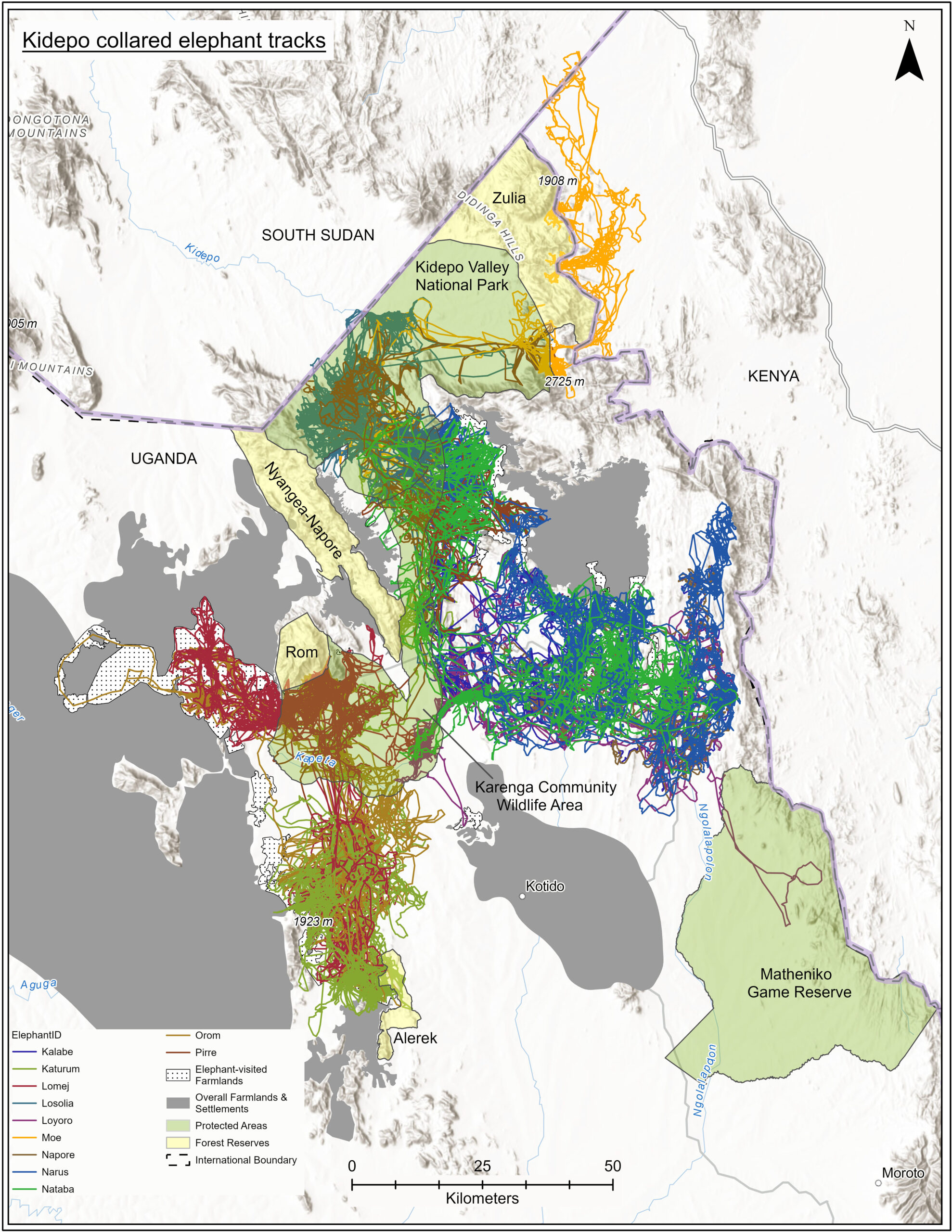
Tracks of Kidepo’s elephants from 2022 to 2024, revealing a wider range not previously known. © Save the Elephants
By March of that year, just one month after the operation, newly collected tracking data revealed elephant movements far wider and more dynamic than previously documented. The data indicated that these elephants use KCWA heavily, range deep into unprotected areas to the southwest and southeast, and even briefly cross into South Sudan. These movement patterns challenged long-held beliefs that the rangeland of elephants in the Kidepo landscape is the national parks and adjacent protected areas, as reflected in earlier reports by the African Elephant Specialist Group.
Data gathered over the subsequent two years has strengthened these findings, indicating that the elephants consistently use pastoral rangelands and farmlands. Four individuals were recorded spending more time in unprotected areas than inside parks in both wet and dry seasons, with one female, Napore, and her family spending all their time outside protected areas. A bull named Moe, travelled from Kidepo to Turkana in Kenya, spending nine months of the year there and crossing briefly into South Sudan via Kenya’s northwestern boundary.
The data also revealed that elephants feel unsafe in parts of Kidepo Valley, inside KVNP, a region that was historically a poaching hotspot. The elephants tended to avoid this area, and those that used it moved faster and covered more ground at night, indicating risk-avoidance behaviour.
Returning to Kidepo
In 2025, STE, UWA, UCF, and KWS, joined by WildLandscapes International and Mara Elephant Project, returned to Kidepo to collar more elephants in the newly discovered elephant rangeland in Kenya’s Turkana area and further south of KWCA in Uganda, as well as provide hands-on training to three newly trained Ugandan vets.
It was a fast paced, complex and collaborative operation. Our team consisted of David Daballen, Director of Field Operations, Giacomo D’Ammando, Research Manager, Purity Milgo, Research Officer, and Angus Carey-Douglas, Pilot. From start to finish, our aircraft flew a total of 2539 miles, ferrying team members to collaring sites, scouting elephants from the air, and guiding choppers ferrying vets for darting and ground teams carrying the collars and personnel for the exercise.
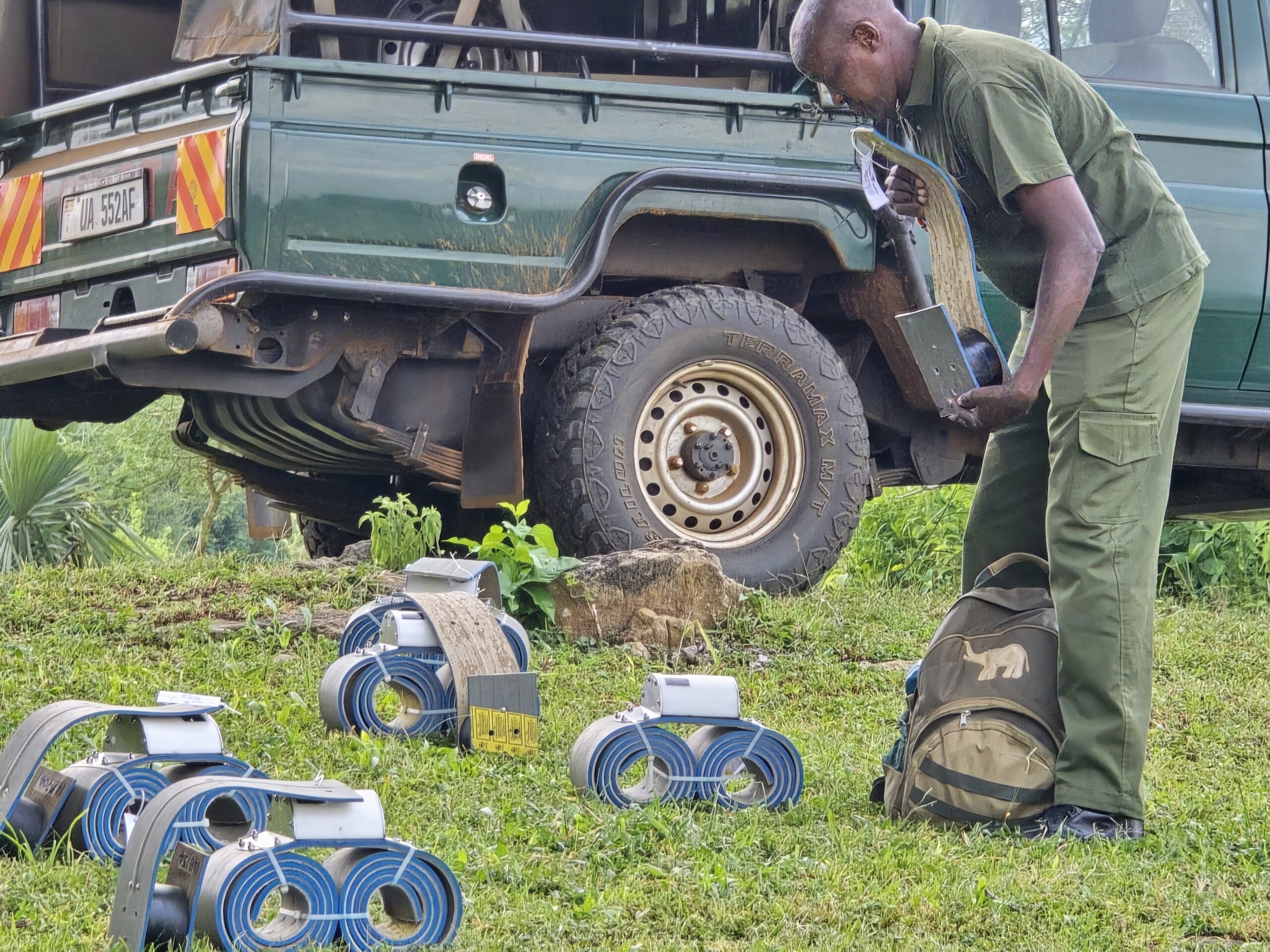
David Daballen with GPS tracking collars to be used during the Kidepo operation. © Purity Milgo/Save the Elephants
The daily operations followed a precise rhythm for the five days of the missions: a morning briefing to align on targets and flight paths, aerial scouting by Cessna aircraft, helicopter deployment of vets to dart selected elephants, and rapid ground team arrival to conduct the collaring before each elephant was safely revived.
But even the best-laid plans were tested by Kidepo’s giants and challenging landscape. Of the 16 elephants collared, six were bulls. Massive individuals, significantly larger than their Samburu counterparts! Several of the bulls were too big for standard collars, so the team had to modify the collars on site to comfortably fit their enormous necks.
Their relatively larger size also introduced another challenge during immobilisation. Bulls falling in a sternal position needed careful and quick handling as their size made it difficult for the team to safely tip them onto their sides, a preferred position for collar placement. These operations became a race against time to minimise stress. The team’s coordination, skill and calm under pressure were vital and critically tested, especially in tight time windows.
Dense vegetation added another layer of difficulty.
“The terrain was another challenge,” explains Purity Milgo, Research Officer at Save the Elephants. “In dealing with the dense vegetation, for example, we had to adapt our collaring protocols, darting elephants away from very thick cover where we would have difficulty working.”

The team fitting a collar on an elephant during the 2025 Kidepo operation © Purity Milgo/Save the Elephants
Thanks to their effective teamwork and enhanced skillset, four collars were deployed on elephants in Kenya, in areas where they frequently interact with local communities. In Uganda’s Kidepo and surrounding areas, 12 new elephants were fitted with GPS tracking collars, their selection focused mainly around communities experiencing crop raiding and increased human-elephant conflict. Three other female elephants from the previously collared population were fitted with replacement collars.
Early insights
The collared individuals provide a well-distributed sample across the countries, and in key conflict zones where movement data is especially valuable. Observations from the collaring operation have already helped shed some light on this little known population.
“Besides fabulous, intact vegetation where in some areas the grass was taller than my height, the elephants are in such good conditions,” says David Daballen, the Head of Field Operations at Save the Elephants.
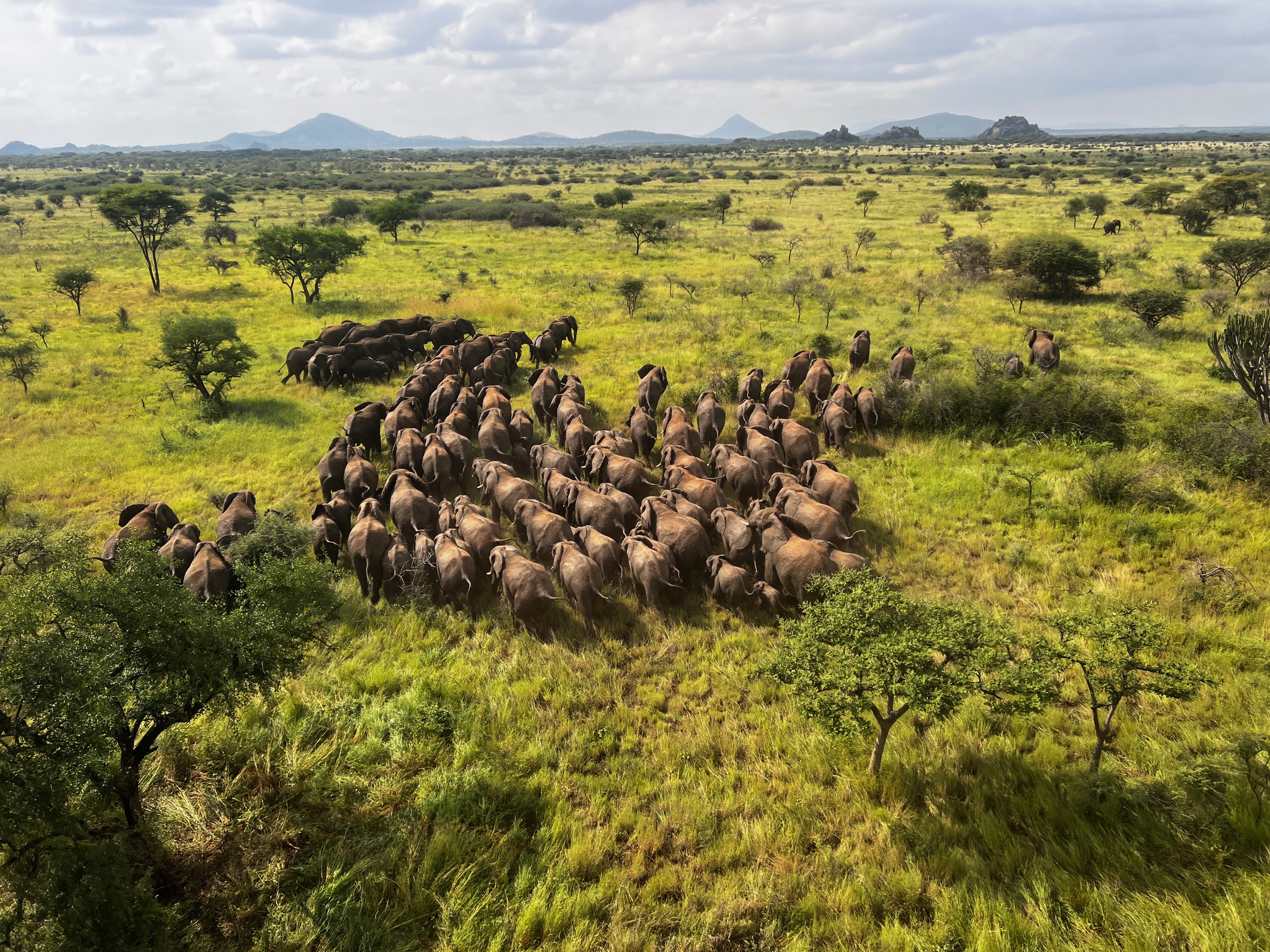
A large herd of elephants in Kidepo, Uganda. © David Daballen/Save the Elephants
Large herds were noted, with groups of 100 to 200 elephants spotted across the landscape.
“Another interesting finding was that there were large groups of elephants bunching together in different parts. About 200 elephants – with a group of bulls – were seen about 62 miles from Kidepo, another 100 animals to the west and another to the south east,” he adds.
While tracking data is still trickling in and analysis being conducted, early findings reveal important movement patterns. Within weeks of the operation, two elephants crossed into South Sudan, not venturing too far into the risky landscape but almost immediately reaffirming the transboundary nature of this population, and painting a richer and more accurate picture of current elephant behaviour in this tri-national system.
With more data coming in, we will gain an even clearer understanding of how they navigate but one thing remains clear; the elephants inhabiting this unique landscape don’t recognise national borders, and increasingly, neither does conservation. From the first Kidepo collaring in 2022 to this year’s expanded effort, the collaboration between the various organisations involved is an indicator of how shared conservation efforts can lead to success.